Norway maple(Acer platanoides 'Emerald Queen')
Emerald Queen Norway maple (Acer platanoides 'Emerald Queen'): dense urban shade tree, milky petiole sap, shallow roots, and critical invasive species alerts.
Complete Plant Information
- Hardiness zones
- USDA 4–7
- Plant type
- Tree
- Plant family
- Sapindaceae
- Sun exposure
- Full sun
- Water needs
- Medium to dry
- Maintenance
- Low
- Height
- 40–50 ft (1219–1524 cm)
- Spread
- 35–45 ft (1067–1372 cm)
- Bloom time
- April
- Flower color
- Erect, showy greenish-yellow corymbs appearing before foliage, followed by wide-spreading samaras
- Flower qualities
- Showy
- Fruit qualities
- Not recorded
- Tolerances
- Drought, Air Pollution, Clay Soil, Road Salt
- Garden uses
- Urban shade tree, large lawn specimen (restricted in many states due to invasiveness)
- Native range
- Europe to Western Asia (cultivar selection)
Field Guide Continues
Ready for care notes, companion picks, and planting tips?
The map is just the start. The full guide below covers growth habits, seasonal performance, and landscape uses.
Overview
Emerald Queen Norway maple (Acer platanoides ‘Emerald Queen’) is a fast-growing, medium-sized deciduous shade tree hardy across USDA Zones 4 through 7. Selected for its rapid growth rate, straight central trunk, and dense, symmetrical upright-oval crown maturing 40 to 50 feet tall and 35 to 45 feet wide, it was historically planted heavily across North America for urban street cooling and park shade. However, gardeners and municipal planners must weigh its tough urban tolerance against its aggressive shallow root system and documented invasive status in eastern and Midwestern woodlands.
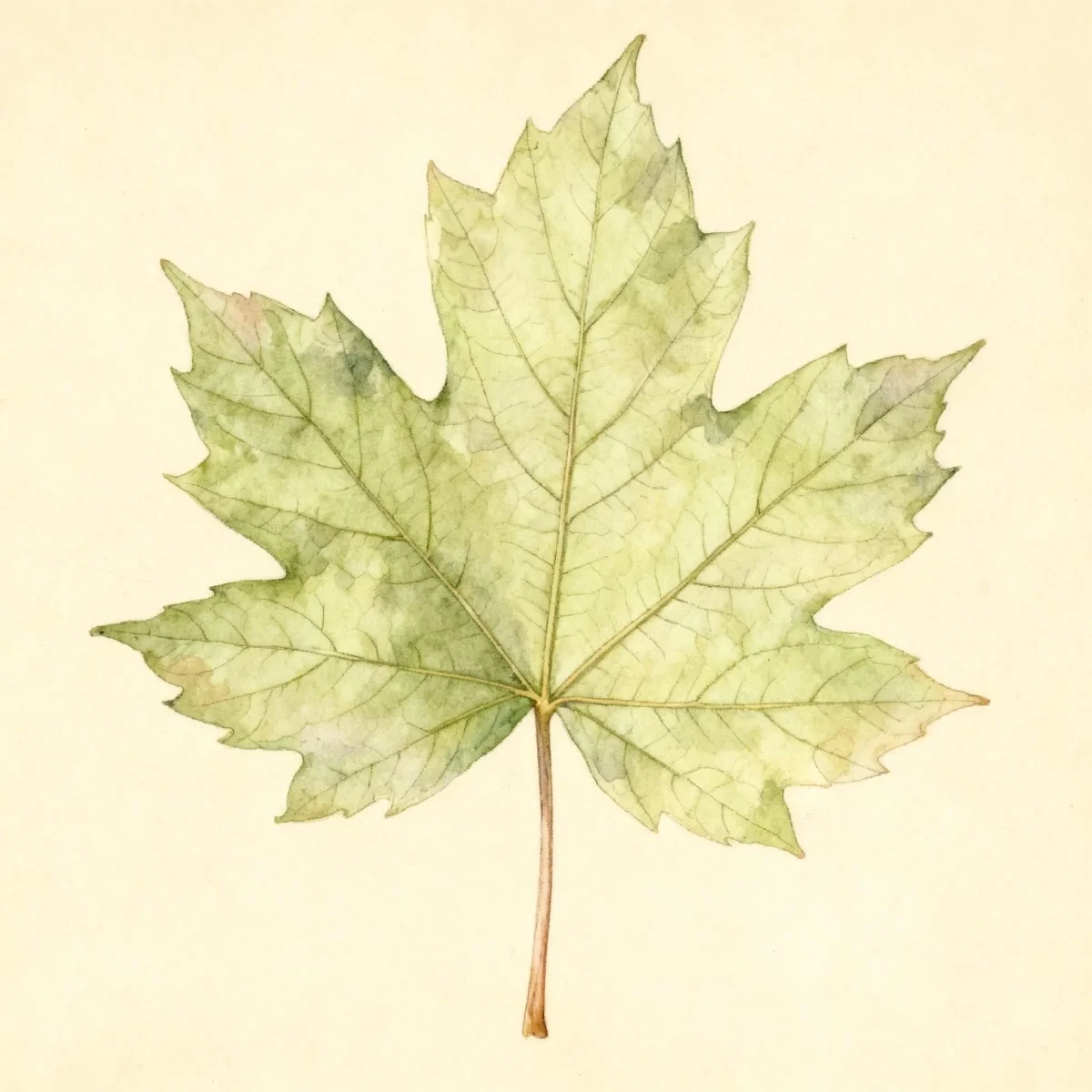
In early spring, showy greenish-yellow flower corymbs burst open along bare branches before dark green 5-lobed leaves unfurl.
How to Grow
- Hardiness & Siting: USDA Zones 4 through 7. Thrives in full sun across a broad range of soil conditions, showing extreme tolerance to heavy clay, high soil compaction, road salt spray, and urban air pollution.
- The Milky Sap Field Test: To distinguish Norway maple from native sugar maple (Acer saccharum), snap a leaf stem (petiole) from a living twig. Acer platanoides exudes an opaque, milky white sap. Native sugar maple exudes completely clear, watery sap.
- Watering: Water thoroughly during the first 2 to 3 years. Mature trees exhibit outstanding drought resistance.
- Pruning Discipline: Like all maples, it bleeds sap profusely if pruned in late winter or early spring during active sap ascent. Prune only during full winter dormancy (November–December) or in midsummer after leaves have fully expanded.
Landscape Uses
- Large Urban Park Specimen: Provides dense, cast-iron shade across large turf lawns and public municipal parks.
- Urban Windbreak & Buffer: Broad crown and tough wood absorb street noise, wind, and city exhaust fumes.
- Autumn Color Canopy: Foliage turns a uniform, bright butter-yellow in late October.
Potential Problems
- Critical Invasive Species Alert: Acer platanoides is classified as a severe invasive exotic tree across the Northeast, Mid-Atlantic, Great Lakes, and Pacific Northwest. Winged seeds scatter into native forests, outcompeting native sugar maples and oaks. Multiple states (such as Massachusetts, New Hampshire, and New York) legally ban its commercial sale.
- Aggressive Surface Roots: Develops a dense, shallow root mat near the surface that cracks sidewalks and makes growing grass underneath impossible.
- Native Alternatives: If planting a large shade tree, choose native Sugar Maple (Acer saccharum), Red Maple (Acer rubrum), or American Yellowwood (Cladrastis kentukea).
Frequently Asked Questions
Is Norway maple invasive?
Yes. It is officially listed as an invasive species in dozens of states and Canadian provinces because its seeds invade native forests and displace native hardwoods.
How do I tell Norway maple apart from sugar maple?
Snap a leaf petiole. Norway maple will bleed white milky sap, while native sugar maple bleeds clear watery sap. Also, Norway maple samaras spread nearly 180 degrees flat, while sugar maple samaras form a U-shape.
Can grass grow under an Emerald Queen Norway maple?
Rarely. The dense canopy blocks nearly all sunlight, and its aggressive shallow surface roots consume all moisture and nutrients.
Companion Plants
Because mature Norway maples produce dense shade and intense root competition, underplant with tough, shade-tolerant groundcovers:
- Tough Shade Groundcovers: Plant with pachysandra, periwinkle (Vinca minor), or English ivy.
- Shade-Tolerant Native Ferns: Interplant with Christmas fern (Polystichum acrostichoides) along its outer drip line.
- Spring Ephemerals: Plant early spring bulbs like daffodils and crocuses that bloom before the dense canopy leafs out.
Sources & Lineage
- Missouri Botanical Garden PlantFinder: Record taxon 254953 (Acer platanoides ‘Emerald Queen’) — morphology, dimensions, and urban culture.
- Kew Plants of the World Online (POWO): Acer platanoides L. (POWO: 781455-1) — species taxonomy, family (Sapindaceae), and European native range.
- USDA Forest Service / Invasive Species: Acer platanoides (Norway Maple) Ecological Risk — woodland displacement mechanisms, distribution maps, and native replacement species.
Recommended Companion Plants
Golden rain tree
Koelreuteria paniculata 'September'
- USDA zones
- 5–9
- Light
- Full sun
- Water
- Dry to medium

Golden rain tree
Koelreuteria paniculata
- USDA zones
- 5–9
- Light
- Full sun
- Water
- Dry to medium
Golden rain tree
Koelreuteria paniculata 'Woodlanders Low Form'
- USDA zones
- 5–9
- Light
- Full sun
- Water
- Dry to medium
Tatarian maple
Acer tataricum
- USDA zones
- 3–8
- Light
- Full sun to part shade
- Water
- Medium to dry
Yellowhorn
Xanthoceras sorbifolium
- USDA zones
- 4–7
- Light
- Full sun
- Water
- Medium
Norway maple
Acer platanoides 'Crimson King'
- USDA zones
- 3–7
- Light
- Full sun to part shade
- Water
- Medium
Keep Learning
Test what you know with a garden quiz
You have the plant facts and care notes. Continue with a related challenge, or browse the complete quiz library.

Can You Identify These Common Garden Plants? Test Your Plant Knowledge
Think you know your roses from your peonies? Test your plant identification skills with our comprehensive garden plant quiz featuring 10 challenging questions.
Start quiz
USDA Garden Zone Map Quiz
Use this USDA garden zone map quiz to check whether you can read hardiness zones and choose plants with more confidence.
Start quizBrowse the full quizzes section
Explore plant identification, zone strategy, and seasonal gardening challenges.
View all quizzes