Beginner Guides
USDA Zone Map for North Carolina: Find Your Growing Zone
Use an interactive USDA zone map for North Carolina, see zones 6a to 9a by region, and learn how frost, elevation, heat, and microclimates affect your garden.
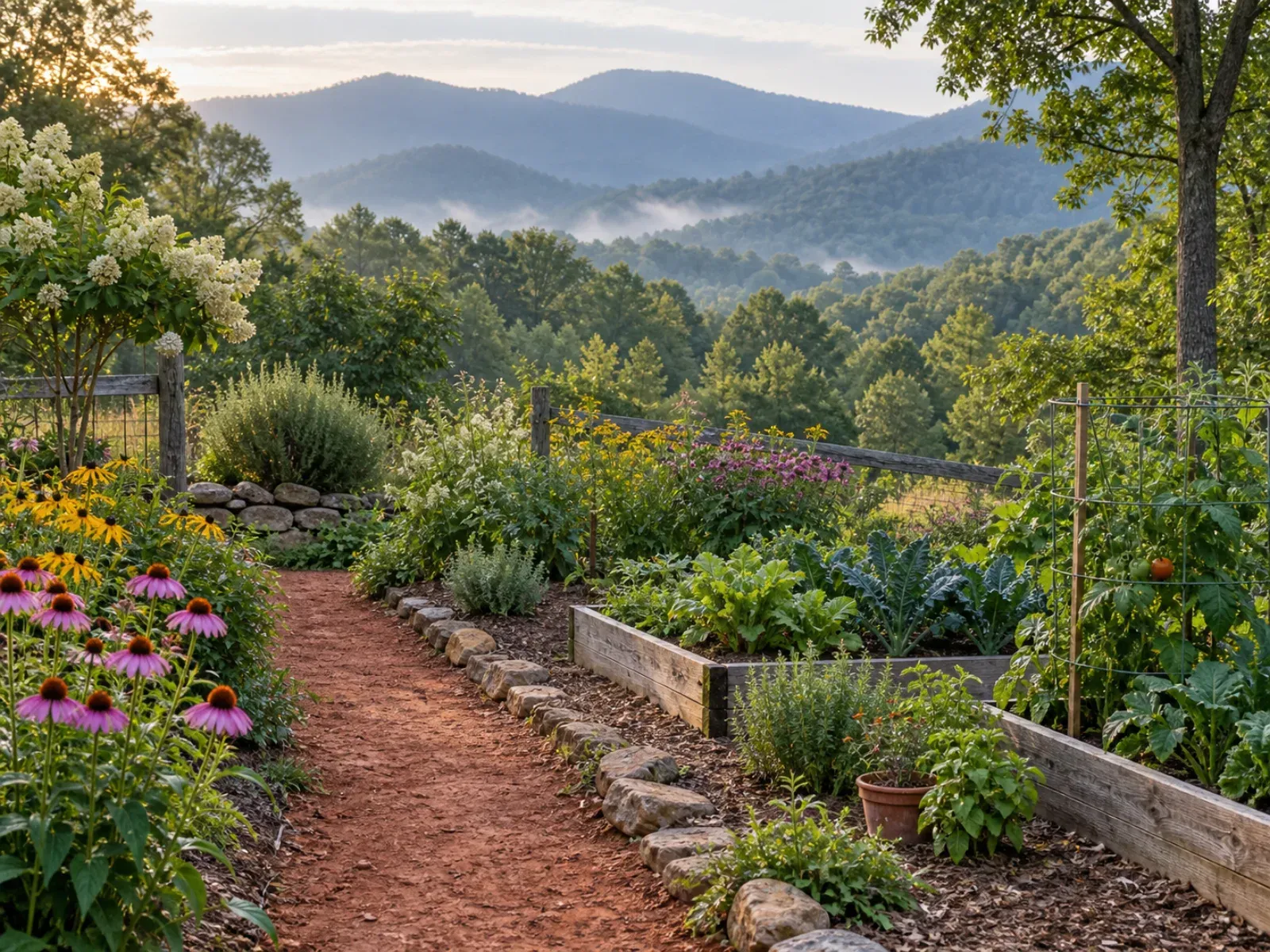
Before sunrise, cold air settles into a hollow near Boone. Farther east, a brick wall in Raleigh holds a little warmth from the day before. On the Outer Banks, salt wind moves through live oak leaves. All three gardens are in North Carolina, but they do not meet winter in the same way.
That is why one zone number cannot describe the whole state.
The 2023 USDA Zone Map for North Carolina runs from Zone 6a in the coldest high mountain areas to Zone 9a along the warmest parts of the coast. Most North Carolina gardens fall in Zones 7a, 7b, 8a, or 8b. Your exact zone depends on your location, elevation, and nearby land and water.
Quick answer: North Carolina includes USDA Zones 6a through 9a. Enter your ZIP Code below for an area estimate, or choose your garden on the map for a more local result.
Loading the interactive hardiness zone map…
Loading the interactive hardiness zone map…
The map gives you a starting point for choosing perennials, shrubs, and trees. It does not tell you when to plant tomatoes, how wet your soil stays, or whether salt spray reaches your porch. We will add those local facts next.
North Carolina Hardiness Zones at a Glance
The USDA divides the country into 10°F zones. Each full zone is split into two 5°F half zones: “a” is the colder half and “b” is the warmer half. These temperatures are average annual extreme minimums. They describe the coldest night in a typical year over a 30-year record, not the normal winter temperature and not the coldest temperature that can ever happen.
| USDA zone | Average annual extreme minimum | Where it appears in North Carolina |
|---|---|---|
| 6a | -10 to -5°F (-23.3 to -20.6°C) | Small areas at the highest mountain elevations |
| 6b | -5 to 0°F (-20.6 to -17.8°C) | High mountain ridges, slopes, and cold pockets |
| 7a | 0 to 5°F (-17.8 to -15°C) | Much of the higher western mountains; Boone ZIP 28607 is an example |
| 7b | 5 to 10°F (-15 to -12.2°C) | Lower mountain valleys, foothills, and cooler parts of the Piedmont; Asheville ZIP 28801 is an example |
| 8a | 10 to 15°F (-12.2 to -9.4°C) | Much of the Piedmont and inner Coastal Plain; Charlotte ZIP 28202 and Raleigh ZIP 27601 are examples |
| 8b | 15 to 20°F (-9.4 to -6.7°C) | Warmer parts of the Coastal Plain and coast; Wilmington ZIP 28401 is an example |
| 9a | 20 to 25°F (-6.7 to -3.9°C) | The warmest coastal and Outer Banks locations; Nags Head ZIP 27959 is an example |
City and ZIP examples are useful landmarks, not boundaries. A ZIP Code can cross more than one local climate. Select your actual garden on the map when you need a closer reading.
What the USDA Zone Number Really Tells You
The USDA Plant Hardiness Zone Map answers one main question:
How much winter cold must a perennial plant be able to survive here?
Suppose a shrub tag says “Zones 5–8.” A North Carolina garden in Zone 7b or 8a falls inside that cold-hardiness range. The shrub has passed its first test. It has not passed every test.
You still need to check:
- Summer heat and warm nights
- Sun and afternoon shade
- Soil drainage and pH
- Rainfall and irrigation
- Humidity and disease pressure
- Wind and salt exposure
- Mature plant size
- Deer and other local pests
This matters in North Carolina because winter cold is not always the hardest part of the year. NC State Extension notes that warm nights can stress plants by increasing respiration and using stored energy. A plant may survive January and still struggle through a hot, wet July.
Use the zone as your cold filter, then use the garden itself as your final test.
Why the Map Changes from the Mountains to the Coast
North Carolina is long from west to east, and its elevation falls from Appalachian peaks to the Atlantic shore. That change shapes the zone map.
Mountains: elevation makes the pattern patchy
Western North Carolina contains the state’s coldest zones, but the map does not move in neat vertical stripes. Temperature changes quickly with elevation and terrain. A high ridge can be colder than a nearby town. On a clear, still night, cold air can drain down a slope and collect in a valley or hollow.
This creates a patchwork of Zones 6a, 6b, 7a, and 7b. Asheville is commonly warmer than higher communities to its north, while individual mountain gardens may sit in a colder pocket than their mailing address suggests.
For a mountain garden:
- Choose woody plants hardy to your mapped zone, or one half-zone colder if the site is exposed.
- Wait for local frost guidance before setting out tender spring plants.
- Protect new roots with mulch, but keep mulch away from trunks and crowns.
- Watch low ground where cold air collects.
- Give broadleaf evergreens shelter from drying winter wind when possible.
Piedmont: winter is milder, summer becomes a stronger test
The Piedmont covers the rolling center of the state. Much of it now falls in Zones 7b and 8a, with local variation. Charlotte and Raleigh are good Zone 8a reference points in the 2023 ZIP data.
Red clay is common, but “red clay” does not tell you how quickly one garden drains. Compacted subsoil can hold water around roots in winter and become hard in summer. Dig a test hole, observe it after rain, and choose plants for the drainage you have.
For a Piedmont garden:
- Match the zone rating first, then screen plants for heat and humidity.
- Give woodland plants relief from strong western sun.
- Improve soil structure over time with compost and surface mulch; do not try to replace all the clay.
- Leave room for airflow around plants prone to leaf disease.
- Water new trees and shrubs deeply during establishment, even when they are drought-tolerant once mature.
Coastal Plain and Outer Banks: mild winter does not mean an easy site
Eastern North Carolina is mostly Zone 8a or 8b, with Zone 9a in the warmest coastal locations. Large bodies of water can soften winter lows. Flat land, sandy soil, high humidity, hurricanes, salt, and wind create a different set of limits.
A Zone 9a label tells you a plant can probably handle the winter minimum. It does not mean the plant can handle salt spray, wet roots, a dry sand ridge, or tropical-storm wind.
For a coastal garden:
- Ask whether the plant tolerates salt and wind, not only whether it is cold-hardy.
- Check drainage after heavy rain and know whether the site can flood.
- Use regionally native, wind-firm plants where exposure is high.
- Water sandy soil according to root depth and actual moisture; do not assume every sandy bed is dry at the same rate.
- Secure young trees with good planting and root establishment, not permanent tight staking.
Zone Is Not the Same as a Frost Date
This is the mistake that causes the most trouble in spring.
Your USDA zone is based on average annual extreme winter cold. A last spring freeze date and first fall freeze date describe the likely edges of the growing season. They are related to temperature, but they answer different questions.
Use the zone for:
- Perennial, shrub, and tree cold-hardiness
- Overwintering bulbs and roots
- Judging how much winter protection a marginal plant may need
Use frost and soil-temperature guidance for:
- Sowing beans or corn
- Setting out tomatoes, peppers, and basil
- Moving tender container plants outside
- Planning fall vegetables
The North Carolina State Climate Office Freeze Date Explorer shows long-term first and last freeze information from stations across the state. Averages are not promises, so keep an eye on the forecast and use a planting calendar from your county’s Cooperative Extension office.
How to Read a Plant Tag in a North Carolina Nursery
Imagine you are holding a perennial marked Zones 6–9, full sun, well-drained soil.
Read it in this order:
- Zone range: Is your garden within Zones 6 through 9?
- Light: Does “full sun” mean at least six hours at this exact planting spot?
- Drainage: Does water leave the root zone after heavy rain?
- Heat and humidity: Is the plant known to perform in your North Carolina region?
- Space: Will its mature width fit without constant cutting back?
- Local pressure: Can it handle deer, salt, wind, or disease conditions at your site?
If the plant is listed only to your exact warm limit, such as a plant rated Zones 4–7 in a Zone 7b garden, winter survival may be fine but summer heat may be the real risk. If your garden is at the cold edge of a plant’s range, such as a Zone 8 plant in Zone 8a, choose a sheltered site and avoid pushing several limits at once.
Good Starting Plants by North Carolina Region
These are starting points, not shopping guarantees. Confirm the species or cultivar, mature size, sun, soil, and local invasive status before planting.
Mountains and cooler foothills
Serviceberry, witch hazel, Virginia sweetspire, mountain laurel, foamflower, Christmas fern, and suitable rhododendrons can fit many western gardens. Site them by moisture, drainage, and light. Mountain laurel and rhododendron need acidic, well-aerated soil; “mountain plant” does not mean “plant in a wet clay hole.”
Piedmont
Eastern redbud, flowering dogwood, inkberry holly, oakleaf hydrangea, switchgrass, little bluestem, asters, and coneflowers are useful plants to investigate. Dogwood often performs best with protection from harsh afternoon sun and with healthy, well-drained soil. Choose disease-resistant cultivars where local guidance recommends them.
Coastal Plain and coast
Yaupon holly, wax myrtle, American beautyberry, dwarf palmetto, live oak, seaside goldenrod, and muhly grass can suit many eastern sites. Near open water, narrow the list again for salt tolerance and storm exposure. A plant native somewhere in North Carolina is not automatically native—or well adapted—to every part of the state.
NC State Extension divides the state broadly into Mountains, Piedmont, and Coastal Plain when discussing native plant fit. That regional layer is often more useful than the state line alone.
Once you know your zone, browse Rita’s plant library by full zone:
Then filter for sun, water, plant type, and the conditions you observed in your yard.
Find the Microclimates the Map Cannot Show
The 2023 USDA map is detailed, with grid cells about half a mile across, but a garden can change within 30 feet.
Walk your yard on a cold morning and mark these places:
- Low pockets: Cold air settles here first.
- South-facing walls: Brick and stone can release stored heat at night.
- North sides of buildings: Winter shade keeps soil and plants cooler.
- Wind corridors: Gaps between buildings can dry evergreen leaves.
- Under eaves: Soil may stay dry even after rain.
- Near large water: Winter temperatures may be slightly moderated, while wind and moisture increase.
- Urban pavement: Concrete and asphalt can create a small heat island.
Keep a simple note for each place: first frost, lowest observed temperature, hours of sun, drainage after rain, and which plants return well. After two or three winters, those notes become more precise than any statewide article.
What Changed in the 2023 USDA Map?
The current map uses weather data from 1991–2020. The previous 2012 map used 1976–2005 data. The USDA says the 2023 map is about one-quarter zone warmer on average across the United States, although some places became cooler because the data and mapping methods also improved.
The new map used 13,625 weather stations and a more detailed grid. Its model considers elevation, coastal influence, temperature inversions, slope, and valleys. That extra detail is especially useful in a state with high mountains, rolling Piedmont, and a long coast.
If your North Carolina garden moved from 7b to 8a, do not remove plants that are doing well. The USDA advises gardeners to treat the map as a guide, not an order to replace a successful landscape. Keep your own winter records and be cautious with plants that sit at the edge of their range.
A Five-Minute North Carolina Zone Plan
You can turn the map into a useful garden decision today:
- Find your point: Use the interactive map above, not only a statewide color band.
- Write down the half zone: Record 7a or 7b, not just Zone 7.
- Check frost timing: Open the State Climate Office explorer and your county planting calendar.
- Name your region: Mountains, Piedmont, or Coastal Plain is a practical first layer.
- Observe the site: Note sun, drainage, wind, and one warm or cold pocket.
- Shortlist plants: Keep only plants whose hardiness range includes your zone.
- Check summer fit: Confirm heat, humidity, moisture, and local pest pressure before buying.
The result is not a longer plant list. It is a better one.
Frequently Asked Questions
What USDA planting zone is North Carolina?
North Carolina spans USDA Zones 6a through 9a on the 2023 map. The coldest zones occur at high elevations in the western mountains. The warmest zones occur along parts of the coast and Outer Banks.
What zone is Raleigh, North Carolina?
The 2023 USDA ZIP listing places central Raleigh ZIP 27601 in Zone 8a. Nearby addresses can differ, especially around urban heat, low ground, and local zone boundaries. Check your own ZIP and map point.
What zone is Charlotte, North Carolina?
Central Charlotte ZIP 28202 is Zone 8a in the 2023 USDA ZIP listing. The wider metro area is not one uniform garden, so confirm your exact location.
What zone is Asheville, North Carolina?
Asheville ZIP 28801 is Zone 7b in the 2023 USDA ZIP listing. Elevation changes quickly around Asheville, and nearby slopes or higher communities may be colder.
Can I grow a plant rated one zone warmer than my garden?
You can try, but treat it as an experiment. Use a sheltered microclimate, start with one plant, mulch the root zone correctly, and accept that an unusual cold snap may kill it. Do not build the main structure of your garden around plants that are not reliably hardy.
Does my USDA zone tell me when to plant vegetables?
No. Use local frost dates, soil temperature, crop needs, and a North Carolina planting calendar. The USDA zone is mainly a guide to perennial winter survival.
The Map Is the Beginning, Not the Garden
Tomorrow morning, the hollow near Boone will still cool faster than the slope above it. The Raleigh wall will still hold warmth. Salt wind will still cross the Outer Banks.
Now those differences are useful clues. Your USDA zone tells you how winter begins the conversation. Your region, frost dates, soil, summer heat, and small garden microclimates finish it.
Find your point on the map. Write down the half zone. Then step outside and learn the few square yards that no statewide map can know as well as you can.
Sources and Further Reading
- USDA Agricultural Research Service: 2023 Plant Hardiness Zone Map
- USDA: How to Use the Plant Hardiness Zone Map
- USDA: How the 2023 Map Was Created
- USDA: North Carolina State Map Download
- NC State Extension Gardener Handbook: Woody Ornamentals
- NC State Extension Gardener Handbook: Native Plants
- North Carolina State Climate Office: Freeze Date Explorer
Hero image created for Rita’s Garden Path.